
The Republic of Turkey from its Founding to the 1960 Coup
The Republic of Turkey was founded by Mustafa Kemal Atatürk on October 29, 1923. Mustafa Kemal, who led the War of Independence, sent İsmet İnönü to Lausanne to reach an agreement with the enemy after the war ended. İsmet İnönü, who reached an agreement in Lausanne, returned to the country with good news. The Republic of Turkey, established under the Lausanne Treaty, struggled with internal rebellions in its early years. The Sheikh Said Rebellion, the Dersim Incidents, and the Menemen Incident were rebellions that shook the Republic in its early years. However, thanks to experienced statesmen, they managed to overcome these rebellions with minimal damage. Many reforms were made during the Republican period. Some of these included the abolition of the sultanate, the abolition of the caliphate, the declaration of the republic, the hat law, the alphabet revolution, the inclusion of secularism in the constitution, and the recitation of the adhan in Turkish. Some of these reforms led to public outcry. The public was uncomfortable with being governed against their beliefs, but they eventually became accustomed to the situation over time. One of Mustafa Kemal's most important steps for the country was the Sadabat Pact and the Balkan Entente. Thanks to these agreements, Turkey was saved from entering World War II. Furthermore, Mustafa Kemal made great efforts for Hatay to join Turkish territory. Following these efforts, Hatay joined the Republican administration in 1939. During his tenure, Mustafa Kemal also made great efforts for Turkey to transition to a multi-party system. To this end, Terakki Perver Cumhuriyet Fıkrası was first established by Kazım Karabekir. However, this party was partly contrary to Mustafa Kemal's views. Moreover, a large part of the party members consisted of former Unionists. For this reason, Kazım Karabekir got into trouble. Accordingly, the party was temporarily closed by the İsmet İnönü administration, and most of the party members were sentenced to death. Initially, an execution order was issued for Kazım Karabekir, and a false accusation of organizing an assassination attempt on Mustafa Kemal was made against him to confirm the execution. However, this was not proven, and Mustafa Kemal forgave Karabekir. Mustafa Kemal's rule continued until his death on November 10, 1938.
The İsmet İnönü Era
İsmet İnönü is among the most important figures in the history of the Republic. İnönü's rule began after the Extraordinary Congress held on November 11, 1938. During his tenure, İnönü opened aircraft and wine factories. He aimed to announce his work to the public by establishing TRT radio. The most important event during his rule was World War II. İnönü's policy of neutrality brought Turkey back from the brink of a major war. Although the country did not enter the war, it emerged wounded. There were soldier casualties in the military units trained for the war. During İnönü's rule, the country officially transitioned to a multi-party system. Laws such as İnönü's land distribution law for farmers led to opposition within the party. Figures like Celal Bayar and Adnan Menderes left the party and founded the Democrat Party. The Democrat Party could not come to power in the first elections due to İnönü's open vote, secret count method. However, in the 1950 elections, İsmet İnönü lost power to the Democrat Party.
The Democrat Party Era
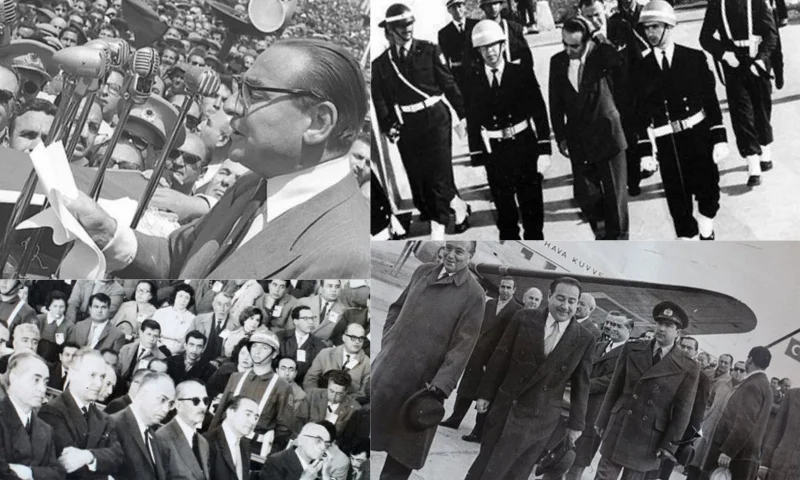
After the Democrat Party came to power, it made some changes in the country. One of these was the re-recitation of the adhan in Arabic. The adhan, which had been recited in Turkish since 1932, was reverted to Arabic. Another development was the recitation of the Quran on state radio three days a week. Such initiatives led to Menderes being loved by the public. Celal Bayar, who was elected President in the new cabinet, was an Ataturkist. This characteristic of his would benefit Menderes in the following years. Prime Minister Adnan Menderes's most important work was the Marshall Plan and being friends with America. The Cold War, which began after World War II, forced all countries seeking to strengthen themselves to choose between America or the Soviets. Turkey's side in this regard was America. The American relations that began with the DP administration enabled the country to benefit from the Marshall Plan. Furthermore, during this period, America opened military bases in Turkey. The biggest step America took in Turkey was the deployment of nuclear missiles to be used against the Soviets. After this step, the missile crisis began with the Soviet counter-attack, but an agreement was eventually reached. One of the events that led to the end of the DP administration, a coup, and the execution of Menderes was Menderes's unconstitutional actions in some of his movements. Furthermore, Menderes's attempt to destroy the CHP was also a factor that led to the coup. After Menderes criticized the Kemalist regime, Turkey's first political coup took place on May 27, 1960, and Cemal Gürsel took over the administration. After the coup, Menderes was executed. An execution order was also issued for Celal Bayar and some DP members. However, they were later pardoned. After this coup, the Turkish people lived under military rule for 6 years.